
Trailing Clouds of Glory
vernacular Firesign Theatre scholarship of 1974

Sad news to hear about the death last week of Tom Stoppard. In 1964, he and Peter Bergman were young playwrights working alongside members of the Gruppe 47 at the Literarisches Colloquium in Berlin. Stoppard was starting a little something with the working title Rosencrantz and Guildenstern in the Court of King Lear; I’ve always wondered if his radio play The Dog it Was that Died had a couple of Firesign shout-outs in it.
Also: Tom Gedwillo writes to say that his archive of Firesign-related materials will be indefinitely available at this link.
One day, near the end of writing Firesign, I decided to procrastinate for a few minutes doing a keyword search for “Firesign Theatre” on a used book website.
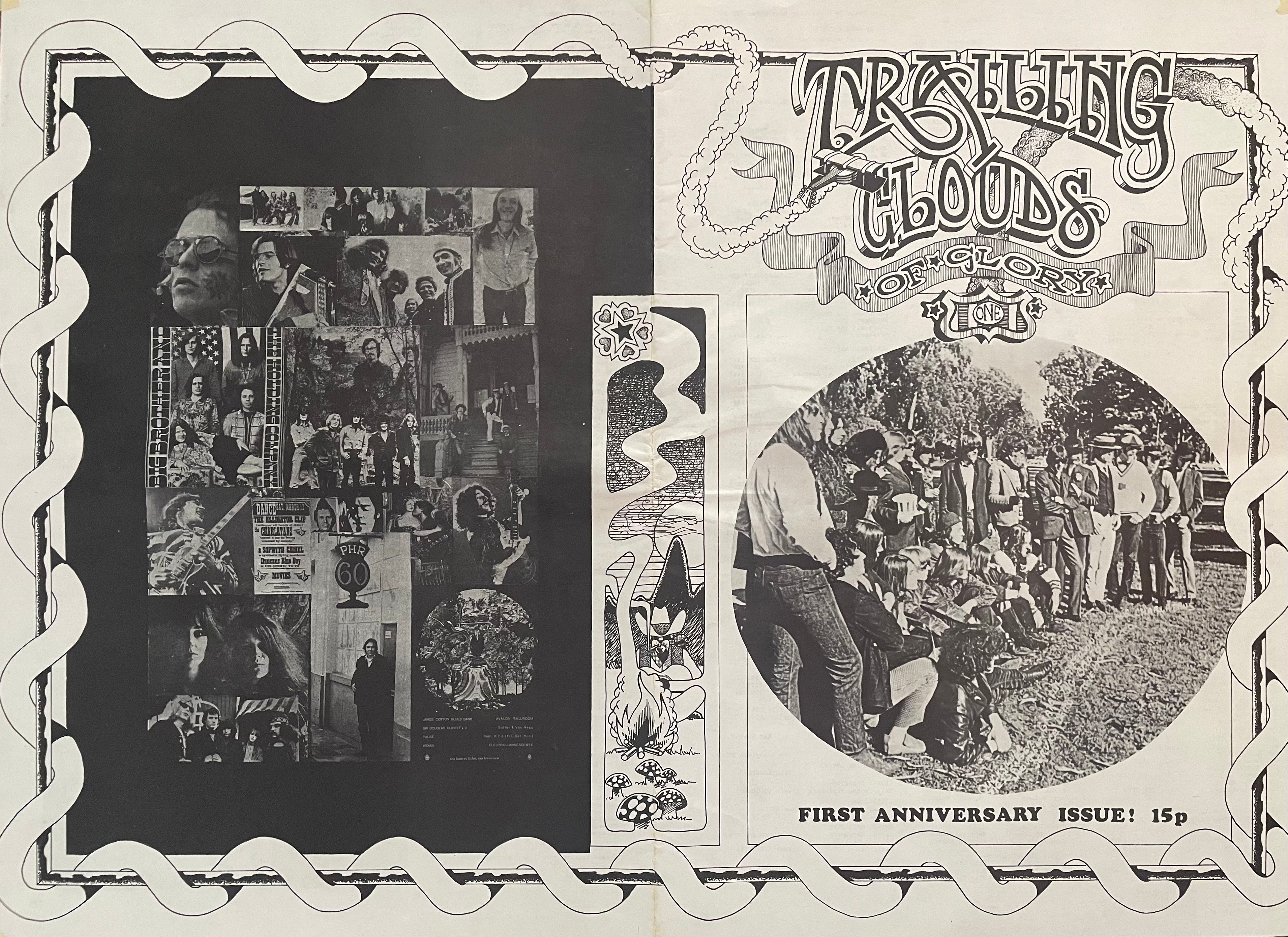
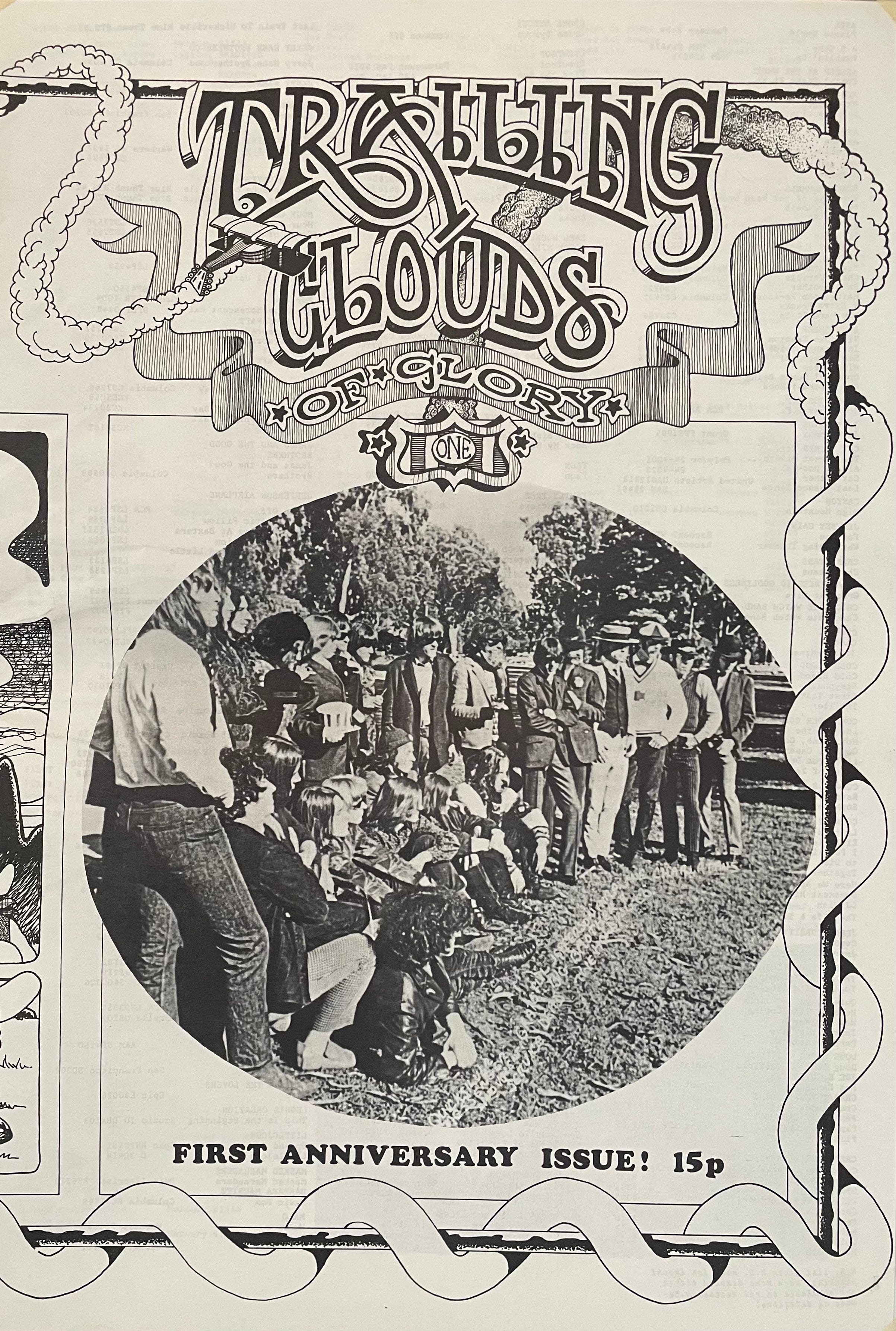
By this point, these searches almost always turned up things I knew, but this time I found something I’d never heard of: a twenty-page music fanzine called Trailing Clouds of Glory, produced in London in 1974 and apparently featuring an article on Firesign Theatre. The title itself was promising because it was either quoting Firesign’s Don’t Crush That Dwarf album or Wordsworth’s Intimations Ode, or — I suspected — both (“we were into the young radical Wordsworth”). It wasn’t cheap, but I pulled the trigger; what arrived in my mailbox a couple of weeks later exceeded my expectations by a long, long way.
By the early 1970s, Firesign albums had been taught classes at “free universities” across the US, as well as less free ones like the New School and UCLA, and had been the subject of a decent article in the academic journal College English.1 There was fan-generated work like Tom Gedwillo’s Chromium Switch fanzine, and I’d discovered at least one hand-made “concordance” to Don’t Crush That Dwarf, explicating as many of the diverse references as it could. There were smart reviews in the rock magazines, especially Detroit’s Creem, and in college newspapers it was common to find reviews that attempted to emulate the Firesign’s wildly associative linguistic style — a dangerous game, for sure.
The multifarious, multiauthored Firesign piece in Trailing Clouds of Glory combined the best of these modes of vernacular scholarship — and best of all, also added THEORY, since they evidently all had access to a bookstore well stocked with Situationist and other texts committed to the radical critique of commercial capitalism. In this way they were making the same connections that the Church of the Subgenius guys were, as I discussed in an earlier post:

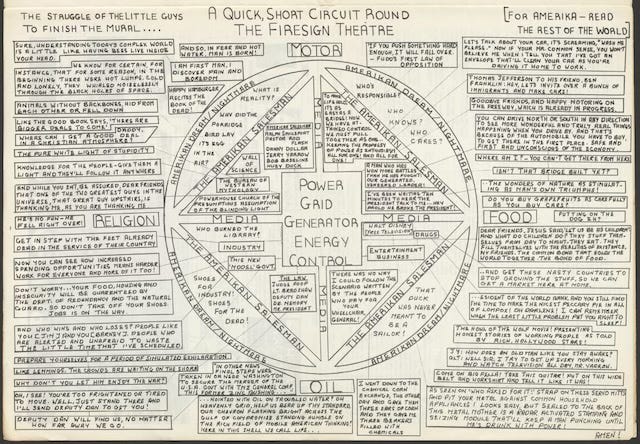
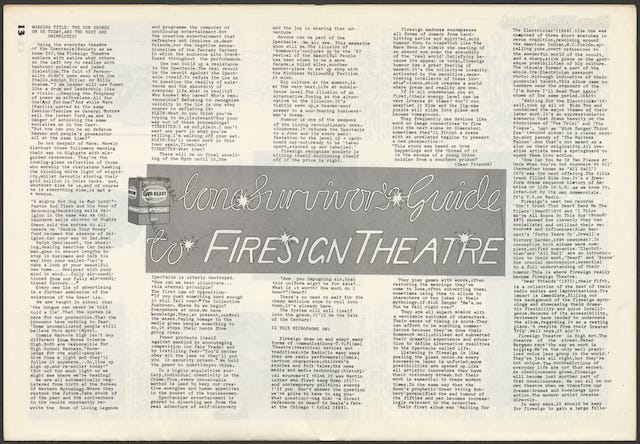
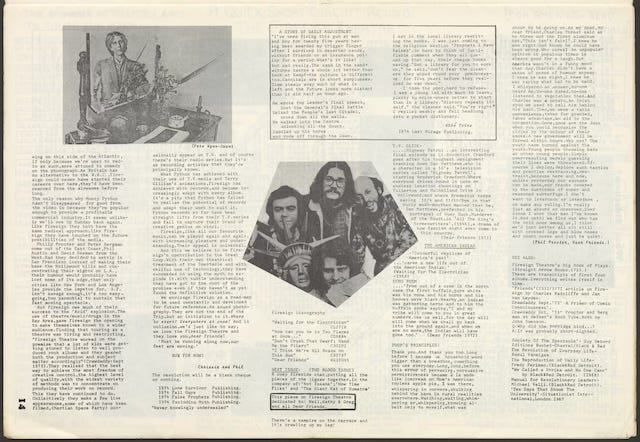
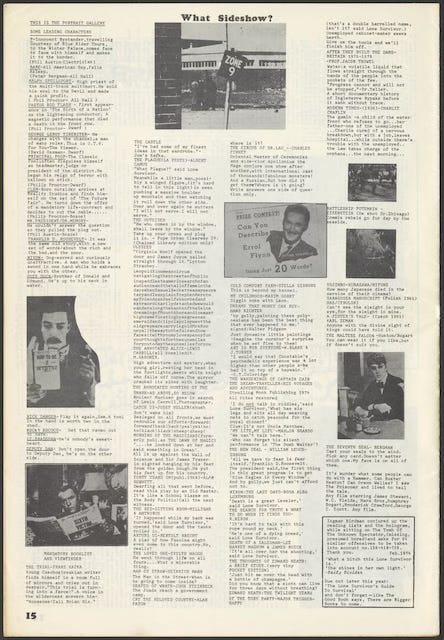
I discussed Trailing Clouds of Glory briefly in the preface to Firesign: The Electromagnetic History of Everything as Told on Nine Comedy Albums, and made a point of reproducing Chrissie Toubkin’s amazing “Quick Short Circuit Round the Firesign Theatre” as the its first illustration. I’m jazzed to reproduce the whole thing here: lengthy excursus, critical bibliography, the “quick short circuit,” fake ads, “mandatory booklist,” and character glossary. Scroll to the bottom for images of all the pages.
In a few days I’ll post my interview with Phil Vellender, one of the authors of these pieces and demiurge behind Trailing Clouds.
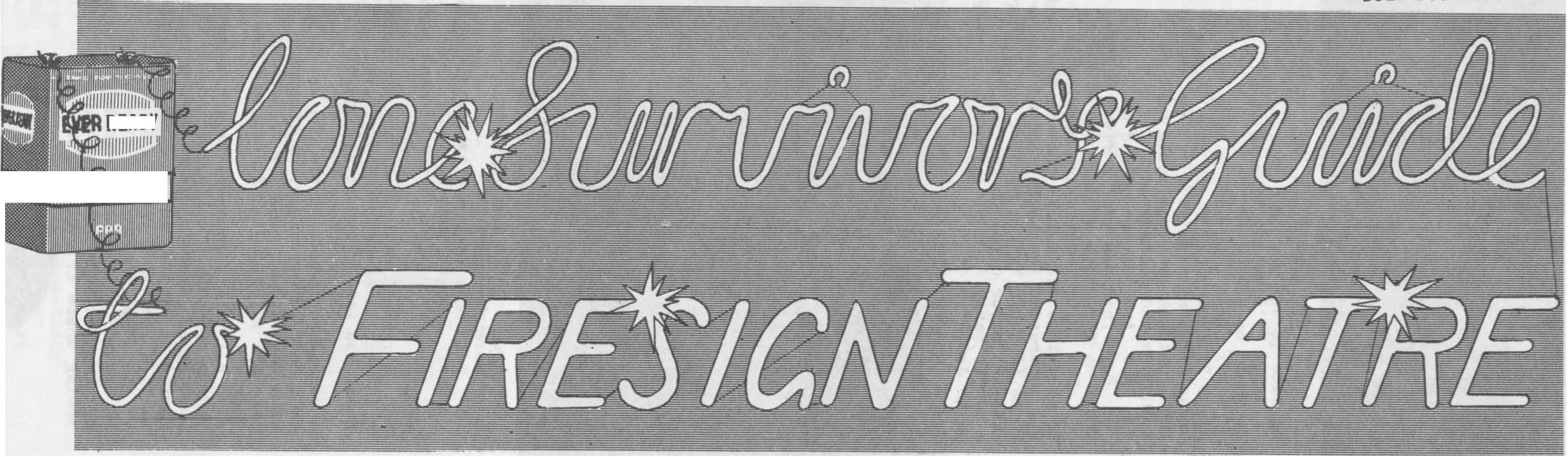
by Christina Toubkin and Phil Vellender
Trailing Clouds of Glory #1 — London 1974
WORKING TITLE: THE SUN SHINES ON US TODAY,
AND THE REST ARE UNEMPLOYED!
Using the everyday theatre of the Spectacle (Society as we know it), the Firesign Theatre achieve with satire what others on the Left try to realise with bankrupt polemics and jaded dialectics. The Cult of Personality didn’t pass away with Joe Stalin, Adolph Hitler or Billy Graham. “I as Leader will use Power like a drum and Leadership like a violin...keeping the Prophesy of power as enthusiasm. All for One! And [all] for One!” And while Marx (Karl) is quoted in the same fashion/fascism as General Motors sell[s] the latest Ford, we are in danger of achieving the same socialism as in the East: “But how can you be my defence lawyer and people’s prosecutor all at the same time?”
Do not despair of Marx. Merely distrust those followers wending their way to Highgate with misguided reverence. They’re the looking-glass reflection of those who worship the charlatans hawking the blinding white light of stupidity, whilst devoutly storing their gold bullion in Swiss deposits. God, whatever else he is, and of course he is everything else, is not a bank.
“A mighty Hot Dog is Our Lord!” — Pastor Rod Flash and his Hour of Reckoning/ Racketing sells Religion in the same way as Col. Saunders [sic lol] sells chicken or Hughie Green sold the system to all takers on “Double Your Money.” Food becomes the essence of Religion. Eat your way to God, Now!
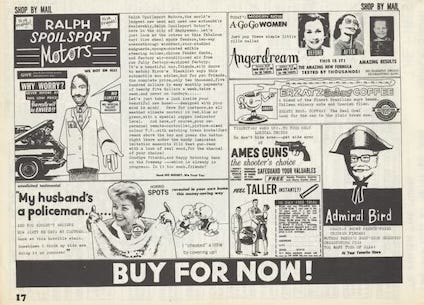
Ralph Spoilsport, the wheeling, dealing Amerikan Car Salesman, goes to absurd lengths to stay in business and talk his way into your wallet — “Let’s take a look at your beautiful new home... designed with your mind in mind...fully [factory] air-conditioned [air] from our fully air-conditioned factory...”
Every new lie of advertising is a further admission of the existence of the Great Lie.
We are taught in school that “the tongue can never be told a lie.” That the system is here for our protection. That the innocent have nothing to fear. “Some uncomplicated people still believe this myth” (Myth).
Commie Martyrs High isn’t any different from Morse Science High. Both are responsible for High School Madness. “Knowledge for the pupil-people — Give them a light and they’ll follow it anywhere ... So, line up sign up, and re-enlist today!” (But not too much light or we might see where we’re heading.)
We are all automatically registered from birth at the Bureau of Western Mythology, where they restock the future, take stock of the past and the scriveners in the vaults constantly rewrite the Book of Living Legends and programme the computer of continuous entertainment. Not the creative entertainment that refreshes and inspires us, dear friends, but the negative sensationalism of the fantasy factory in which the audience sits transfused throughout the performance.
One can build up a resistance to the Spectacle. The real revolt is the revolt against the Spectacle itself. To refute the Lie is to question the reality of existence and the absurdity of everyday life. What is reality? Who knows? Who cares? Who’s responsible? Refusing to recognize validity in the Lie is one step nearer to defeating it:
KLEIN: What do you think you’re trying to do, Lieutenant? Buy your way out of these proceedings?
TIREBITER: I am out, Klein. I don’t want any part in what you’re selling. I’m walking off your set.
KLEIN: You’ll never work in this town again, Tirebiter!
TIREBITER: What town?


There will be no final unveiling of the Myth until it, the Spectacle is utterly destroyed. “How can we best illustrate... this eternal principle? The First Law of Opposition — ‘If you push something hard enough it will fall over.’” The Collective Pushover. Where do we begin? Everywhere at once. We have knowledge. They, at present, control the means. Paying homage to the media gives people something to do, it stops their hands from going crazy.
Power protects itself against mankind by encouraging competition (or Fair Trade) and by instilling fear — “You’d better obey all the laws or they’ll put you in security prison.” We hold the power to question, to think.
In a highly acquisitive society, individual creativity is the Crime. Thus, every conceivable method is used to keep our creative energies and human appetites in the pocket of the businessmen.
Spectacular entertainment is geared to diverting us from the real adventure of self-discovery and the joy in sharing that adventure.
Anyone can be part of the Spectacle. We all are. This magazine soon will be. The illusion of “community” conjured up by the ’67 revival of the Beautiful People has been shown to be a mere facade, a blind alley, another market-place to set up shop with the Mindless Fellowship Pavilion in mind.
Hip culture at the moment is, at the very best, Life at subsistence level. The illusion of an alternative. Posing as the alternative to the illusion. It’s tightly sewn up, a heaven-sent answer to a God-fearing businessman’s dream.
Humour is one of the weapons of the Living revolutionary consciousness. It reduces the Spectacle to a Joke and its every manifestation to the level of a cardboard cut-out, ready to be “taken apart, stacked up and labeled.”
Firesign recognise society is killing itself. Auctioning itself off if the price is right. “Are you impugning sir, that this uniform might be for sale?.. What is it worth? How much do I hear?” (Dwarf)
There’s no need to wait for the cheap medicine show to roll into town, it’s already here.
The System will sell itself into the grave. It’ll be the Sale of the Century!
IS THIS MICROPHONE ON?
Firesign draw on and adapt many forms of communications — TV; Films; Theatre; theatrical devices and traditions; 40s Radio (in many ways they are radio performers); Comix; cartoon characters; children’s stories and folk tales; the news media and media technology; historical sources — (I think it was Martin Luther who first sang Hymn 15172) — and contemporary political events (“If you don’t answer the question we’re going to have to gag you — What question? — Gag him! — a direct reference on Dwarf to [Bobby] Seale’s fate at the Chicago 7 trial 1969).
Firesign madness encompasses all forms of comedy from hardhitting satire and spirited, acid humour thru to slapstick like the Marx Bros. Or simply the casting of an absurd eye over the absurdity of the “real world.” Satisfying because its appeal is total, Firesign humour has a great feeling of warmth. It’s the collective insanity activated by the sensitive, penetrating intellects of these lovable clowns, which creates a world where dream and reality are one.
If it all overwhelms you at first (their energy level can be very intense at times) don’t run away! Let it flow and the jig-saw puzzle will slide into place and become homeground.
They frequently use devices like word or image connectives to flow into the next scene or dimension; sometimes they’ll finish a scene with an unrelated tagline to present a new perspective: “This story was based on true happenings and the thread of it is the escape of a young Union soldier from a southern prison.” (Dear Friends)
They play games with words, often restoring the meanings they’ve come to lose, often subverting them, sometimes using them to allude to characters or key jokes in their mythology, c.f. Nick Danger “He’s, no fun he fell right over.”
They are all superb mimics with a veritable suitcase of characters. Their sense of timing is acute. They can afford to be scathing commentators because they’ve done their homework well, utilised and subverted their dramatic experience and education to define alternative realities to the Spectacle called Life.
Listening to Firesign is like peeling the glass onion. As every successive layer is unfurled, more possibilities are opened up. Like all artistic innovators they have their visionary streak. But their work is essential to these modern times. In the same way that the Goons’ prophetic “Great String Robbery” personified the mad humour of the fifties and yet becomes increasingly relevant to the seventies.
Their first album was “Waiting for the Electrician” (1968). Side One was composed of three short sketches in revue tradition, revolving around the American Indian, W.C. Fields, appalling puns, overt references to the wonderful world of the occult, and a sharp, slick piece on the grotesque possibilities of hip culture. The visuals formed a part of the whole (re: Electrician passport photo). Although indicative of their potential talent, this album came nowhere near the standard of the “I’m Sorry I’ll Read That Again” shows of the same period (68-69).3
“Waiting for the Electrician” itself took up all of Side Two and contained the major themes of their later work. It’s an expressionistic scenario that draws heavily on the storylines of “The Trial” and “The Plague,” just as “Nick Danger Third Eye” (second album) is a clever shot- by-shot parody of “The Maltese Falcon.”4 And that’s not meant as a slur on their originality. All creative artists need a springboard to spark them into action.
“How Can You Be In Two Places At Once When You’re Not Anywhere At All” (hereafter known as “All Hail”) 1969 was the next offering. The title track filled Side One. It’s a freeform dream sequence history of America or life in LA as we know it, inter-cut by its own commercials. It’s TV on Radio.
Firesign’s next two records “Don’t Crush That Dwarf Hand Me The Pliers” (Dwarf) 1970 and “I Think We’re All Bozos On This Bus” (Bozos) 1971 showed how cleverly they had assimilated and utilised their resources and influences (Alan Bennett’s “Forty Years On,” Orwell’s Victory Garden, 1984 newspeak). In conception both albums were complete, unified scenarios. “Electrician” and “All Hail” are an introduction to their work, “Dwarf” and “Bozos,’ the crucial centrepoint, essential to a full understanding of their humour. This is where Firesign really become Firesign Theatre.
“Dear Friends” (1972), their fifth, is a collection of the best of their radio series and improvisations. Its impact is immediate, filling out the background of the Firesign mythology and showcasing their dramatic flexibility and quick intelligence. Because of its accessibility, reviewers have tended to underrate the album, regarding it as a resting place. “A respite from their Greater Trip.” Well boys, it ain’t!
Firesign Theatre is High Art. The theatre of the street. Peter Bergman says “the way we work is riffing. We’re the only well practiced voice jazz group in the world.” They’re jazz all right, but they’re not unique. The contradictions of everyday life are not that secret. As consciousness grows, Firesign will become just another part of that consciousness. We can all be our own theatre when we transform our dreams/dramas and knowledge into action. The modern artist creates directly.
In many ways, it should be easy for Firesign to gain a large following on this side of the Atlantic, if only because we’re used to radio as such, more attuned to comedy on the phonograph. As Britain has no alternative to the BBC, Firesign could never have started their careers over here, they’d have been removed from the airwaves before long.
The only reason why Monty Python hasn’t disappeared for good from the video is because they’re popular enough to provide a profitable commercial industry. It seems unlikely we’ll see Up Sunday back again. Like Firesign they both have the same radical approach; like Firesign they have touched on the future possibilities of the media.
Philip Proctor and Peter Bergman come out of the East Coast, Phil Austin and David Ossman from the West. Had they decided to settle in San Francisco instead of making their base the Hollywood hills and concentrating their sights on LA, their humour would probably have lost some of its edge, that only cities like New York and Los Angeles provide the impetus for. SF isn’t savage enough, it’s too easy-going, too parochial to sustain that fast moving spectacle.
But Firesign owe much of their success to the “Acid” explosion. The use of theatre/music/drugs in the Bay Area gave Firesign the opening to make themselves known to a wider audience. Finding that touring as a theatre was tiring and restricting, “Firesign Theatre worked on the premise that a lot of kids were getting stoned to listen to well produced rock albums and they geared both the production and subject matter accordingly” (Crawdaddy, Sept 1973). They realised that the best way to achieve the most freedom of creative control, the highest level of quality, with the widest variety of methods was to concentrate on producing their work on record. This they have continued to do. Collectively they make a few live appearances, some of which have been filmed (Martian Space Party), occasionally appear on TV and of course there’s their radio series. But it’s as recording artistes that they’re principally known.
What Python has achieved with their use of TV media and Terry Gilliam’s animations, Firesign has achieved with records, becoming increasingly adept with every album. It’s a pity that Python has failed to realise the potential of records and adapt their work to suit it. Python records so far have been straight lifts from their TV series and fail to capture their brand of creative genius on vinyl.
Firesign, like all our favourite music, can be played again and again, with increasing pleasure and understanding. Their appeal is universal.
And this we believe to be Firesign’s contribution to the Great Coup. With their own theatrical treatment of the Spectacle and with skillful use of technology, they have succeeded in using the myth to explode it. With subtle understanding they have got to the root of the problem even if they haven’t as yet found the definitive solution.
We envisage Firesign as a road-map to be used constantly and developed for future reference. As sound photography. They are not the end of the Trip, but an initiation to it. Where to start? Everywhere at once! And in collusion, we’d just like to say, we love the Firesign Theatre and they love you, dear friends!
“Must be running along now, our feet are moving.”
BUY FOR NOW!
Chrissie and Phil
The revolution will be a blank cheque or nothing.
1974 Lone Survivor Publishing.
1974 Fall Guys Publishing.
1974 False Prophets Publishing.
1974 Exploding Myth Publishing.
“Never knowingly undersealed’’
This piece on Firesign Theatre dedicated to: Neil, Kathy & Greg and all Dear Friends.
NEXT ISSUE: (THE BLOOD ISSUE)
A cosy fireside chat, putting all the pieces of the jigsaw together, in the company of: “Not Insane”; “How Time Flies” and “The Giant Rat of Sumatra”
There’s a vampire on my terrace and it’s crawling up my leg!5
SEE ALSO
Firesign Theatre’s Big Book of Plays. (Straight Arrow Books (72)) These are transcripts of first four albums. Everything writes itself in time.
Friends #23 (2/2/71) — article on Firesign by Charles Radcliffe and Jan van Leyden.
Crawdaddy (Sep. 73) “A Primer of Comic Consciousness” by John Swenson.
Crawdaddy (Oct. ’73) “Proctor and Bergman at Hefner’s Boob Tube” by John Swenson.
Q:Why did the porridge bird...?
A:It was probably short-sighted.
Society of the Spectacle by Guy Debord (Editions Buchet — Chastel/Black & Red).
The Revolution of Everyday Life by Raoul Vaneigem.
The Reproduction of Daily Life by Fredy Perlman (Black & Red Detroit).
“We Called a Strike and No One Came” by Black & Red Detroit (1968).
Manual for Revolutionary Leaders by Michael Velli (Black & Red Detroit).
“Ten Days That Shook the University” by Situationist International, London 1967.
THIS IS THE PORTRAIT GALLERY / SOME LEADING CHARACTERS
P—Innocent Bystander, traveling courtesy of Blue Rider Tours, to the Winter Palace, comes face to face with himself and makes it to the border. (Phil Austin—Electrician)
BABE — All American Boy, Falls Asleep. (Peter Bergman—All Hail)
RALPH SPOILSPORT — High priest of the multi-track multimart. He sold his soul to the Devil and made a quick profit. (Phil Proctor — All Hail)
PASTOR ROD FLASH — First appearance in “Birth of a Nation” as the lightening conductor [sic]. A magnetic performance that died a death in the front row. (Phil Proctor — Dwarf)
GEORGE LEROY TIREBITER — He changes with the channels, a man of many roles. This is UTV For You — The Viewer. (David Ossman — Dwarf)
PRINCIPAL POOP — The Classic Fool often disguises himself as headmaster, judge or president of the district. He began his reign of terror with balloon on stick. (Philip Proctor — Dwarf)
CLEM — Born outsider arrives at Reality Studios and finds himself on the set of “The Future Fair.” He turns down the offer of a mandatory life-contract and decides to cut the cable. (Philip Proctor — Bozos)
MR. PRESIDENT/DR. MEMORY — He couldn’t answer the question so they pulled the plug out. (Phil Austin — Bozos)
FRANKLIN D. ROOSEVELT — It was the same old story, with a new set of words about the rich and the bad, and the poor.
NIXON — Dog-eared and curiously unattractive. A man who holds a sword in one hand while he embraces you with the other.
HUEY DUCK — Brother of Donald and Edmund. He’s up to his neck in water.
NICK DANGER — Play it again, Sam. A tool in the hand is worth two in the shed.
ROCKY ROCOCO — Get that raven out of here.
LT. BRADSHAW — He’s nobody’s sweetheart.
DEPUTY DAN — Don’t open the door to Deputy Dan, he’s on the other side.


MANDATORY BOOKLIST AND VIEWFINDER
THE TRIAL — FRANZ KAFKA
Young Czechoslovakian writer finds himself in a room full of mirrors and cries out in despair, “This trial is turning into a farce!” A voice in the wilderness answers him — "Nonsense! Call Brian Rix.”
THE CASTLE
“I’ve had some of my finest ideas in that wardrobe.’’ — Joe’s Kafka.
THE PLAGUE (LA PESTE) — ALBERT CAMUS
“What Plague?" said Lone Survivor. Meanwhile a little man, possibly a winged figure (it’s hard to tell in this light), is seen pushing a massive boulder up mountain and then watching it roll down the other side. Over and over again he mutters “I will not serve. I will not serve.”
THE OUTSIDER
”He who comes in by the window, shall leave by the window.” Take up your cross and plug it in. — Pope Urban Clearway IV. (Chained Library edition only)
ULYSEES [sic]
“Virginia Woolf opened the door and James Joyce sailed straight through it.” Lytton Strachey.
LeopoldBloomwascircumnavigatingthestreetsofDublininapaddlesteamerinsearchofanaudienceandthehalloffameinthedayswhenSamuelBeckettwasmysecretaryandIwasplainStephenHerotomyfriendsandselfabsorbedandextraordinarilydetachedwewouldwanderalongthebanksoftheSeinedreamingofMountAboraandicemasthighcamefloatingbyasgreenasemeraldandclipclapclopwenttheoldgreymarecarryingoldMrsRooneyallthewaytothefairandhowfaresitwithyoumyloveapennyforyourthoughtsforthesunsmilesforyoutodaythesunsmilesforyou
THE ANNOTATED ALICE — LEWIS CARROLL (all kneel) edit. M.GARDNER.
High adventure and mystery, when young girl, resting her head in the footlights, meets white knight who falls off horse. The mirror cracked its sides with laughter.
THE ANNOTATED HUNTING OF THE SNARK — AS ABOVE, SO BELOW
Ancient Mariner goes in search of Lewis Carroll, Photographer.
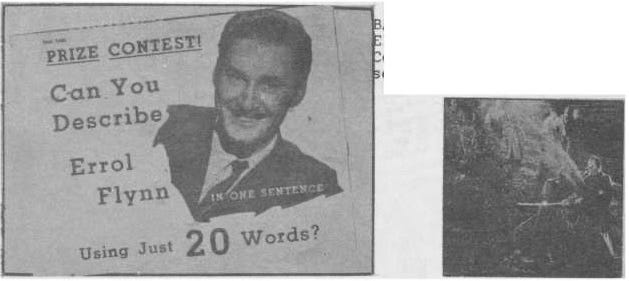
CATCH 22 — JOSEF [sic] HELLER (shush don’t wake him)
Besieged on all fronts, we must redouble our efforts—forward! forward!back!back!yes!yes!no! no!black!black!sheep!sheep!
MORNING OF THE MAGICIANS (formerly publ. as THE DAWN OF MAGIC)
“....he looked down at her and said something in Greek.” All is up against the Wall of Science and Sir James Frazer is sighted hanging by his feet from the golden bough. He put his feet up for his country.
FORTY YEARS ON (publ.1968) — ALAN BENNETT
Dwarfing all that went before, read this play by an Old Master. It’s like a School blazer on the Body Politic! Call the next witness.
THE BED-SITTING ROOM — MILLIGAN & ANTROBUS
“It happened while my back was turned,” said Lone Survivor, “opened the door and the tanks rolled in.”
ARTURO UI — BERTOLT BRECHT
A play of how Fascism might even come to this country. No, really?
THE LOVED ONE — EVELYN WAUGH
He went through life on all fours....What a miserable thing.
MAN OF STRAW — HEINRICH MANN
The Man in the Street — When is he going to come inside?
GRAPES OF WRATH — JOHN STEINBECK
The Joads reach a government camp.
CRY THE BELOVED COUNTRY — ALAN PATON
Where is it?
THE CIRCUS OF DR. LAO — CHARLES FINNEY
Oriental Master of Ceremonies and side-kick Apollonius the Mage conjure one show after another, with international cast of thousands! Fabulous monsters! And a Russian. But how did it get there? Where is it going? Write answers one side of question only.
COLD COMFORT FARM — STELLA GIBBONS
This is beyond my kennel.
MY CHILDHOOD — MAXIM GORKY
Diggin coke with Leon.
DREAMS THAT MONEY CAN BUY — HANS RICHTER
“by golly, painting these Polynesians has been the best thing that ever happened to me.” signed: Walter Pidgeon. Just dynamite little paintings — imagine the curator’s surprise when he set fire to them!
ART IS FOR EVERYONE — W. BLAKE & J. TURNER
“I would say that Constable’s psychedelic experience was a lot higher than other people’s — he had it on top of a haywain.’ — S.T. Coleridge
THE WANDERINGS OF CAPTAIN CAIN
THE DREAM-TRAVELLER: HIS VOYAGES AND ADVENTURES.
Strolling Monk Publishing 1974. All rites restored.
“I do not talk in riddles,” said Lone Survivor, “What has six legs and sits all day weaving nets to catch peacocks for the royal dinner?” Clue: It’s not Uncle Matthew.
“MY LIFE, MY LIFE” — MARLON BRANDO
“We can’t talk here.” Who can forget his silent performance in “The Dumb Waiter”?
THE NEW DEAL - WILLIAM LEUCHENBURG [LEUCHTENBERG]
“All we have to fear is fear itself.” Franklin D. Roosevelt. The president said, the first thing in this great program is to get “Blue Eagles in Every Window.” And by golly, we just can’t afford not to.
NIXON: THE LAST DAYS — ROSA ALBA LUXEMBURG
“Death is a great Leveler,” said Lone Survivor.
THE SEARCH FOR TRUTH & WHAT TO DO WHEN IT FINDS YOU — R. NIXON
“It’s hard to talk with this rope round my neck.” “He’s one of a dying Breed,” said Lone Survivor.
DEATH OF A SALESMAN — LEE HARVEY MAGNUM & JAMES BUICK
“It’s all over bar the shooting,” said Lone Survivor.
THE THOUGHTS OF EDWARD HEATH: A BRIEF STUDY (very tiny POCKET EDITION)
“Just hit me over the head with a bottle of champagne.” Did you know that a sloth can live for three days without breathing?
EDWARD HEATH: THE TWILIGHT YEARS OF THE TORY PARTY — MAJOR TRIGGER-HAPPY
(That’s a double barrelled name, isn’t it? said Lone Survivor.) Unemployed cabinet-maker seeks berth. Give us the tools and we’ll finish him off.
AFTER THEY BUILT THE DAMS — BRITAIN 1975-1979 — PROF. JACOB TROWEL
Water: a volatile liquid that flows straight through the hands of the people into the pockets of the few. “Progress cannot and will not be stopped.’’ — Dr. Teller. A short documentary history of Ingleterre Bypass before it sank without trace.
MODERN TIMES (1936) — CHARLIE CHAPLIN
The gamin — a child of the waterfront who refuses to go...her father — one of the unemployed ...Charlie cured of a nervous breakdown, but with a job, leaves hospital...while outside there’s trouble with the unemployed… the Law takes charge of the orphans...the next morning...
BATTLESHIP POTEMKIN — EISENSTEIN (He shot Dr. Zhivago)
Commie rebels go for day by the seaside.
YOJIMBO — KURASAWA/MIFUNE
How many Japanese died in the service of their cinema?
SARAGOSSA MANUSCRIPT (Polish 1965) — HAS/CYBULSKI
Can’t see the sleight in your eye, for the sleight in mine.
A JESTER’S TALE (Czech 1965) — KARL ZEMAN
Anyone with the divine right of kings could have told it.
THE MALTESE FALCON — Huston/Bogart
You can wear it if you like, but it doesn’t suit you.
THE SEVENTH SEAL — BERGMAN
Cast your seals to the wind. Pick any card. Doesn’t matter which one. My face is on all of them. It’s murder what some people can do with a Hammer. Can Buster Keaton? Can Orson Welles? I saw The Prisoner and lived to tell the tale.
Any film starring James Stewart, W.C. Fields, Marx Bros, Humphrey Bogart, Broderick Crawford, George C. Scott. Any film.
Ingmar Birdman conjured up the reading lists and the hologram, while sitting on The Tomb Of The Unknown Spectator, (missing, presumed bored) and asks for 64 similar offensives to be taken into account no.156-418-726.
Thank you. Feb. 1974
“What a bitch this Lone Survivor is.”
“She shines in her own light.”
—Daily Divider
Due out later this year: “The Lone Survivor’s Guide To Survival” and don’t forget—like The Good Book says, There are Bigger Books to come.
M.C. Beard, “The Firesign Theatre: A Review,” College English 33.3 (Dec. 1971) 379-82. https://doi.org/10.2307/375035.
1517 is the year of Martin Luther’s 95 Theses.
I’m Sorry I’ll Read That Again broadcast on BBC radio from 1964 to 1973 and starred John Cleese, Tim Brooke-Taylor, Graeme Garden, David Hatch, Jo Kendal, and Bill Oddie. Now in the public domain, late episodes can be found here: https://archive.org/details/im-sorry-ill-read-that-again_202108

TV GLIDE—
…...Highway Patrol … an interesting final episode as Lt. Broderick Crawford goes after his toughest assignment tracking down Dan Matthews, who is a character in a 50’s television series called “Highway Patrol,” starring Broderick Crawford. Where everyone drives round in cars on endless location shootings on Fullerton and Mulholland Drive in Hollywood; and where Broderick keeps saying 10-4 and 21-50-Bye in that surly mush-mouthed manner that he, Dan Matthews, perfected in his portrayal of Huey Duck, Murderer of the South, in “All The King’s Screenwriters” (1946), a drama of how fascism might even come to this country. (Dear Friends 1972)
THE AMERICAN INDIAN
—“Colourful replicas of America’s past”
—“carve a new life out of the American Indian” (Waiting For The Electrician -1968)
ECHO POEM
.... “From out of a cave in the north came the first buffalo, pure white was his robe and his horns and his hooves were black. Nearby, an Indian was gathering herbs and to him the buffalo spoke saying, ‘I and my tribe will come to you in great numbers. Use us well, for the day will will come when we shall go back into the ground again, and when we are no more, the Indian will have gone too.’” (Dear Friends, 1972)
POOP’S PRINCIPLES:
Thank you. And thank you too. Long before I became a household word bigger than a breadbox, something you use every day; long, long, before this error of pervasive, persuasive permissiveness became à la mode like ice cream on Mom’s American topless apple pie, I was there, whispering in corners, skulking behind the barn in rural realities everywhere. Watching, waiting, whimpering er whispering, knowing albeit only to myself, what was about to be going on. As my dead, my dear friend, Charles Throat said as he threw out the first aluminum bat, “This isn’t fair!” I knew he was right. God knows he could have been wrong. Who cares? An unpopular opinion in populous times is always good for a laugh. But America wasn’t in a funny mood that day. Charles didn’t have a sense of humour anyway. I knew he was right, I knew he was saying what had to be said. I whispered an answer, no-one heard me. No-one cared. No-one listened to vegetables then. And Charles was a potato. An Irish spud we used to call him behind his back. Then, we were a table convenience, taken for granted, taken advantage, an aid to the congestion. Gone, gone are the days when you could recognise the cities by the colour of their smoke. A new government will be formed within hours. Why not? The youth have turned against the youth. Young people throwing bats at other young people. Simply over-reacting merely guessing their lives were threatened. Of course I deploy, deplore such tactics and practise restraining restraint, because here and now, unlike yesterday our excuses can be made, our tracks covered by the dustbrake of sober and reasoned subterfuge. I don’t want to intercede or interfere, or make any ruling. I’m really just an absurd er observer. Ever since I shot that man I’ve known it. And until we find out who has the cold nose among us, I think we’d just better all sit still with crossed legs and blow noses and count noses and just be quiet. (Phil Proctor, Dear Friends.)