
everywhere it's Christmas
the Beatles Christmas records and the Beatles-Firesign connection

Season’s greetings, all. With apologies to those who were here a year ago, I’m reposting here last year’s piece on the Beatles’ Christmas records. It sure would be nice to see a proper release of these sometime! Links to all of them are below. Check it out if you haven’t heard them before.
The Cornell Library has posted the video of the talk I gave in September. It’s from the radio/How Can You Be in Two Places at Once chapter of Firesign and includes images and audio that couldn’t make it into the book. This pairs with this fall’s series of posts on Firesign’s radio sources. If you stick around to the end, you’ll hear that the first question is from someone whose sister dated Peter Bergman when he lived at the Farm! More on the Farm, probably, in 2026.
Everywhere it’s Christmas (slight return)
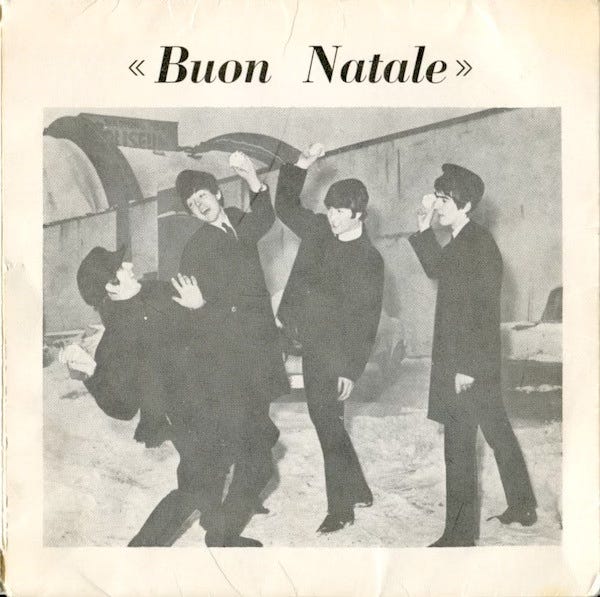
If you’re a hardcore Beatle nerd like me, then you’ll probably be familiar with their annual Christmas records —> five- to eight-minute recordings made between sessions, pressed on cheap vinyl flexi disc, and sent to their fan club members every year from 1963 to 1969. To play them in sequence is like making a short album that is also a kind of shadow history of the band. I’m only partly kidding when I say that it’s my favorite Beatle album.
Each record, for one thing, registers the status of their friendship, which was such a key aspect of what made the Beatles so distinctive and so appealing (“we were really very close, you know” said George dryly in the 90s), and no doubt made their breakup so painful to fans of their generation.
By 1966, you can also hear them turning the constraint of yet another obligation into an opportunity to experiment with recording techniques and make the recordings into something more theatrical (an extreme and distinctive version of something I wrote about earlier). Put slightly differently, the Beatles Christmas records are the closest the Beatles ever came to making comedy records (Robert Christgau: “on top of everything else, they were the funniest rock stars ever”). As Devin McKinney has rightly noticed, by 1967 the fan club discs begin to sound like the records the Firesign Theatre were about to make.
I haven’t seen anything that suggests that Firesign knew the Christmas records (not all of them were released in the United States, at first). But they both knew and also, to some extent, modeled themselves on the Beatles, as attested by the dozens of references that famously populate Firesign’s second album How Can You Be in Two Places at Once When You’re Not Anywhere at All.
That’s a rabbit hole into which I avidly descend in Firesign: The Electromagnetic History of Everything as Told on Nine Comedy Albums. But it was only after the book came out that I got confirmation that the Beatles were themselves Firesign fans. While Lennon’s “Not Insane” pin was a clue, Firesign insider Steve Gillmor told me that he had been present at a Columbia Records event in the 1970s when George Harrison passed by Proctor and Bergman, saluting them with a quote from Waiting for the Electrician: “Civilization, ho!”
The most interesting and extravagant of the Beatles Christmas records — 1966, 1967, and 1968 — are not currently available on YouTube. So instead I commend you to listen to them on the Internet Archive (where they can also be downloaded). Since they’ve already been amply discussed elsewhere — by McKinney, by Andrew Hickey (who is always great on the links between rock music and comedy), and in a journalistic overview in Rolling Stone — I’ll try to hew my comments toward the Firesign connection.


1963 / The Beatles Christmas Record
1964 / Another Beatles Christmas Record
1965 / The Beatles Thirds Christmas Record
The first three Christmas records are all artifacts of the Beatlemania years. They address the fans directly — “you’ve stayed loyal, haven’t you?” says Ringo with the perfect mix of warmth and irony — and they are obviously reading from, and deforming, scripts written for them by their publicist Tony Barrow. Paul: “hope you’ve enjoyed listening to the records as much as we’ve loved melting them.” This was an extension of the banter made famous in their press conferences and then adapted in the Hard Day’s Night movie — a playful rapport that was both public and private (“we talk in code to each other as Beatles,” Lennon would later say1), and resembles the riffs and verbal jamming that would later distinguish the Firesign Theatre’s radio programs, as with their travestying performance of the “Golden Ring Club” that I discussed a few weeks ago.
Things begin to change in 1965, when the Beatles took a break from the Rubber Soul sessions for a fan club greeting that they were now ad-libbing. There’s much to say about this one, but what is most notable for Firesign Theatre people is the way it is much more discursive, the group members interacting more and putting on different voices (including women’s voices) so that at times it becomes a parody of World War II broadcasts on the BBC — “Let’s play a request for all the boys in B.A.O.R.E. […] we got some fans in the forces, you know” (Ringo); “especially those abroad and those of you in B.O.R. 2459783” (John, in female voice). It weaves from this nostalgic parody to singalong travesties of “Yesterday” (which George seems particularly to enjoy) to a shocking extemporized mash-up of “Auld Lang Syne” and Barry McGuire’s “Eve of Destruction” that openly names the Vietnam War, a year and a half before the march on the Pentagon.
Should auld acquaintance be forgot
And never brought to mind?
Down in Vietnam and China, too
And look at all those bodies Jordan
Floating in the River Jordan
Firesign were attentive to the links between World War II and Vietnam too. But however bracing the trajectory of these first three xmas records may be, they would probably not still be worth hearing today were it not for the ones that followed it.
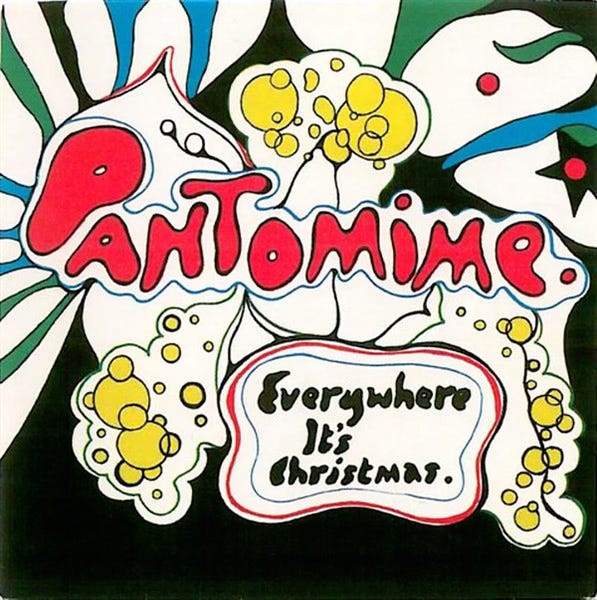
1966 / Pantomime (Everywhere it’s Christmas)
One day into the recording sessions that would result, seven months later, in Sgt. Pepper’s Lonely Hearts Club Band, the Beatles took a day out to record a correspondingly high concept Christmas record. Leaving behind the convention of addressing the fans directly, Everywhere it’s Christmas is a surreal, multimodal radio drama that combines the English tradition of the Christmas “panto” with an overt homage to the cult humor of The Goon Show, the anarchic 1950s BBC radio program that starred Spike Milligan, Peter Sellers and Harry Seacombe.2 It’s no accident that this was also the first of their Christmas records that they would ask George Martin to produce: as they well knew, Martin had cut his teeth at EMI as a producer of comedy records, including releases by Milligan and Sellers.
The Beatles had grown up with the Goons and their shaggy outré thirty-minute plots would be inspirational for the Firesign Theatre, too. Firesign’s Phil Austin heard them syndicated on the NBC radio program Monitor, and they would later program Goon Show episodes periodically on KPFK. Describing the scripts Firesign wrote for their weekly broadcasts from the Magic Mushroom club in 1967, David Ossman told me:
Our model was The Goon Show and we knew because I had interviewed people from The Goon Show and knew how the show was done. Like Sellers would make this big entrance and there was pre-show stuff, and just also the unexpected funny voices or funny characterization, beyond the funny writing, you know.3
It would not be hard to imagine the early Firesign Theatre performing a cover of Pantomine (Everywhere it’s Christmas). Apparently a coherent narrative (which in fact it is not) the 1966 Christmas record is a nonsense assemblage of ten scenarios, which include
(in Corsica) “is a bearded man in glasses conducting a small choir,” which sings a parody of Christmas hymn, as
“meanwhile in the Swiss Alps two elderly Scotchmen munch on a rare cheese”
which abruptly shifts to a chaotic party in a tent
and cuts again to the Captain’s mess of the HMS Tremendous for a toast to the queen
before a pastiche of a children’s book presents “Podgy the Bear and Jasper” making methodical arrangements to go down to the shop for candles, matches and buns, while
“in the long dark corridors of Felpin Mansions a door slams and the shadowy figure of Count Balder appears.” John, declaiming loudly in an abusive German accent, requests “one of the good old tunes,” which
becomes a song that I have been singing constantly this year to the (at first) amusement and (by now) annoyance of my family: “Please don’t bring your banjo back / I don’t know where it’s been / […] Banjos, banjos all the time / I can’t forget their tune. / And if I ever see another banjo / I’m going out to buy a big balloon!”
Availing itself of an echo chamber, in situ sound effects (“Foley”), and library music, Pantomime is a radio homage which could have been broadcast live (as The Goon Show was) in a kind of parody of the BBC World Service. In retrospect, the fact that its drama puts you in ten places at once (when you’re not anywhere at all) makes it sound today like an allegory of the multitrack techniques they would pioneer with the song they had just begun recording, “Strawberry Fields Forever.”


1967 / Christmas Time is Here Again
The 1967 record is best remembered for containing successive iterations of the only Beatles Christmas song that could be released as a single (and it eventually was). But it is just as remarkable for the way it extended the Goons pastiche of the Pantomime into the era of multitracked psychedelia, once again with the collaboration of George Martin.
Like the 1966 record, it begins by suggesting a storyline (“the boys arrive at BBC House [for an audition] in the fluffy rehearsal room”). It pursues this plot nominally for about sixty seconds before a parody of an advertising jingle (“Get Wonderlust for your trousers / Get Wonderlust for your hair!”) commences a sequence of fragmentary pastiches of radio and television broadcasts — talk show, game show, Theatre Hour — treated and intercut with tape echo, piped-in applause and crowd reactions, sound effects, and lots of library music. Eerily resembling The Who Sell Out (which was released on the very same day, December 15), Christmas Time is Here Again strongly anticipates the channel-surfing collage narratives of the Firesign Theatre’s How Can You Be in Two Places at Once and Don’t Crush That Dwarf, Hand Me the Pliers.
Recorded between the filming of the Magical Mystery Tour movie and the opening of the Apple Boutique (the latter emblazoned with a mural by Peter Bergman’s friends from Amsterdam, Marijke Koger and Simon Posthuma), the Beatles 1967 Christmas record definitively belongs to this same period of psychedelic optimism. It is also the most successful of the three extramusical projects, and the last time the Beatles would collaborate together on a Christmas record.


1968 / The Beatles 1968 Christmas Record
1969 / The Beatles Seventh Christmas Record
The final two Beatles Christmas records in many ways together narrate a declension narrative, the first one striving (and mostly succeeding) to make a virtue of the band members’ divergences, and the other more dispiritingly embodying the group’s demise.
The 1968 release is without question the White Album of the Beatles’ Christmas records. Recorded by each of the band members separately — as appeared to have been the case for so much of the White Album, at least spiritually — and then stitched together with tape effects and other sonic links, the record intends to compose its disparate pieces as a whole that celebrates the still-amazing plenitude of the Beatles experience. Spiked with sound effects and drop-ins — including a very early Moog synthesizer — it at times has the flavor of “Revolution 9,” which in turn reveals the way “Revolution 9” is itself a comedy track. Another way that The Beatles 1968 Christmas Record resembles the White Album is how well, despite everything, it all works. But it’s also hard not to register the absence of the magic of their interactions, not to mention the subtle aggression that manifests differently (and characteristically) in each of their separate recordings.
Paul’s contribution is to improvise a Christmas song in the mode of“Mother Nature’s Son,” on an acoustic guitar. His aggression takes the form of showing how Paul doesn’t need the others. By contrast, John’s aggression is, inevitably, both the meanest and the one expressing the most profound pain. In this case, his subject is the other band members’ reception of Yoko Ono. Over noodling piano, he recites a self-penned vignette in the punning style of In His Own Write or “Jabberwocky” that barely makes an effort to disguise its grievance:
Once upon a time, there were two balloons called Jock and Yono. They were strictly in love, bound to happen in a million years. They were together, man. Unfortunatimetable, they seemed to have previous experience which kept calling them one way or another (you know how it is). But they battled on against overwhelming oddities including some of their beast friends.
Not very Chirstmasy!
Ringo’s contribution is a slightly hysterical tape-edited pastiche of a telephone call (in which he performs both sides of the call), which follows his genial and reassuring greeting, “Hello, this is a big hi and a sincere merry Christmas from yours truly, Ringo Starr!” (As Ellen Willis wrote in her White Album review, “Ringo, you keep us all sane.”)4
But it is George who exhibits the most disdain for the project while at the same time winning the unspoken competition that is the 1968 Christmas record. Making a point of sending his greetings from America, George turns the mic over to the ukelele-strumming sui generis pop star Tiny Tim, who wishes us all a Merry Christmas before performing an over the top falsetto demolition of “Nowhere Man” which has to be heard to be disbelieved. For those who have not caught on to the seasonal Dickensian gag, George provides the stinger by dispatching his guest with the words, “Thank you, Tiny. Thank you and god bless you, Tiny.”
A year later, the seventh and final Christmas record is a bummer but (like Let it Be) contains a few worthy moments and in any case must be heard. George and Ringo make perfunctory appearances, the latter obligingly and the former grudgingly. There is another lovely acoustic track knocked off by Paul, seemingly in his sleep. The most substantive sequences on this record, surprisingly, are provided by John and Yoko together, who are by turns affecting and aggravating, singing together and chatting: “We've had the swinging sixties, and I was wondering, Mrs. Lennon, how have you saw your place in the seventies?” “I think it'll be a quiet, peaceful seventies,” says Yoko, “hopefully, you know.”
I hope so, too!
When I was writing Firesign and poring over rock publications, I came across a great early interview with the Ramones. They were all Beatles fans, as everyone knows, even taking their name from the alias (Paul Ramone) that Paul would use at hotels in the early days. When the interviewer, Lisa Jane Persky (who just joined Substack, hello!), asks them admiringly about their all-for-one and one-for-all identity (gabba gabba hey), Tommy and Johnny respond with this exchange:
Tommy: RAMONES is an entity in itself. All four of us feel that when we work together we are the RAMONES. Just like the Beatles were the Beatles and the Stones were the Stones.
Johnny: The Stones aren’t the Stones.
Tommy: In the beginning they were.
Johnny: The Beatles were the Beatles but the Stones were never the Stones. They were always individuals.5
A subject for another day: Firesign was Firesign but Python was never Python! For now, let’s conclude with what we can imagine, in this context, as the Ramones’ tribute to the Beatles Christmas records — which they most assuredly knew. “Merry Christmas, I don’t want to fight tonight!” Wishing everyone a peaceful holiday season.
Lennon quoted in Rob Sheffield, Dreaming the Beatles: The Love Story of One Band and the Whole World (New York: William Morrow, 2017) 144.
Jonathan Gould gives a good discussion of Beatles and Goons in Can’t Buy Me Love: The Beatles, Britain, and America (New York: Harmony, 2007) 49-50; Andrew Hickey gives a great gloss on the English pantomime tradition here: https://500songs.com/podcast/xmas-bonus-christmas-time-is-here-again-by-the-beatles/
David Ossman, interview with Jeremy Braddock, April 14, 2016.
Ellen Willis, “Records: Rock, Etc. — The Big Ones,” The New Yorker (1 Feb. 1969): 63. Willis also points out that, in trying to abandon what George called the Beatles’ “kiddie image,” they had ironically made in the White Album “a terrific children’s album.”
Lisa Persky, “Are the Ramones, or is the Ramone?” New York Rocker (Sept. 1976): 28.
I find the Beatles Christmas records fascinating and appreciate your in depth analysis as they progressed from merely fan club obligations to the 1966 and later George Martin produced comedic efforts. Good to know that the Internet Archive has included these later Christmas gems. Researching this subject I discovered that there was a limited edition box set release in 2017.<https://youtu.be/-HtBDK0y9-k> I was not aware of this. The Firesign Theatre references to their lyrics always stood out to me. My late wife saw the Beatles at the Hollywood Bowl in 1965 when she was a teenager!
Thanks for suggesting Julia Barton's 𝘊𝘰𝘯𝘵𝘪𝘯𝘶𝘰𝘶𝘴 𝘞𝘢𝘷𝘦 newsletter. I subscribed and am glad that I did. Her nod to The Library of Congress was wonderful and timely. Jeremy, I know you can appreciate that considering your dedicated research for your Firesign book. In particular the Recorded Sound Research Center must continue to be preserved and protected, especially from the authoritarian Congresspeople who derive pleasure from defunding and erasing American culture.
I'll be posting the link to your Cornell Library talk on my Firesign Facebook group. Happy Holidays!
Beatles! Christmas! Firesigns! - It's Christmas time and time to mix Firesigns with appropriate seasonal material. We were talking about and listening to some of the Christmas messages the Beatles recorded for their fans on my producer Tweeny's Tuesday radio show and I began formulating this week's collage.
Part 1
Part 2
Part 3